 Conectando
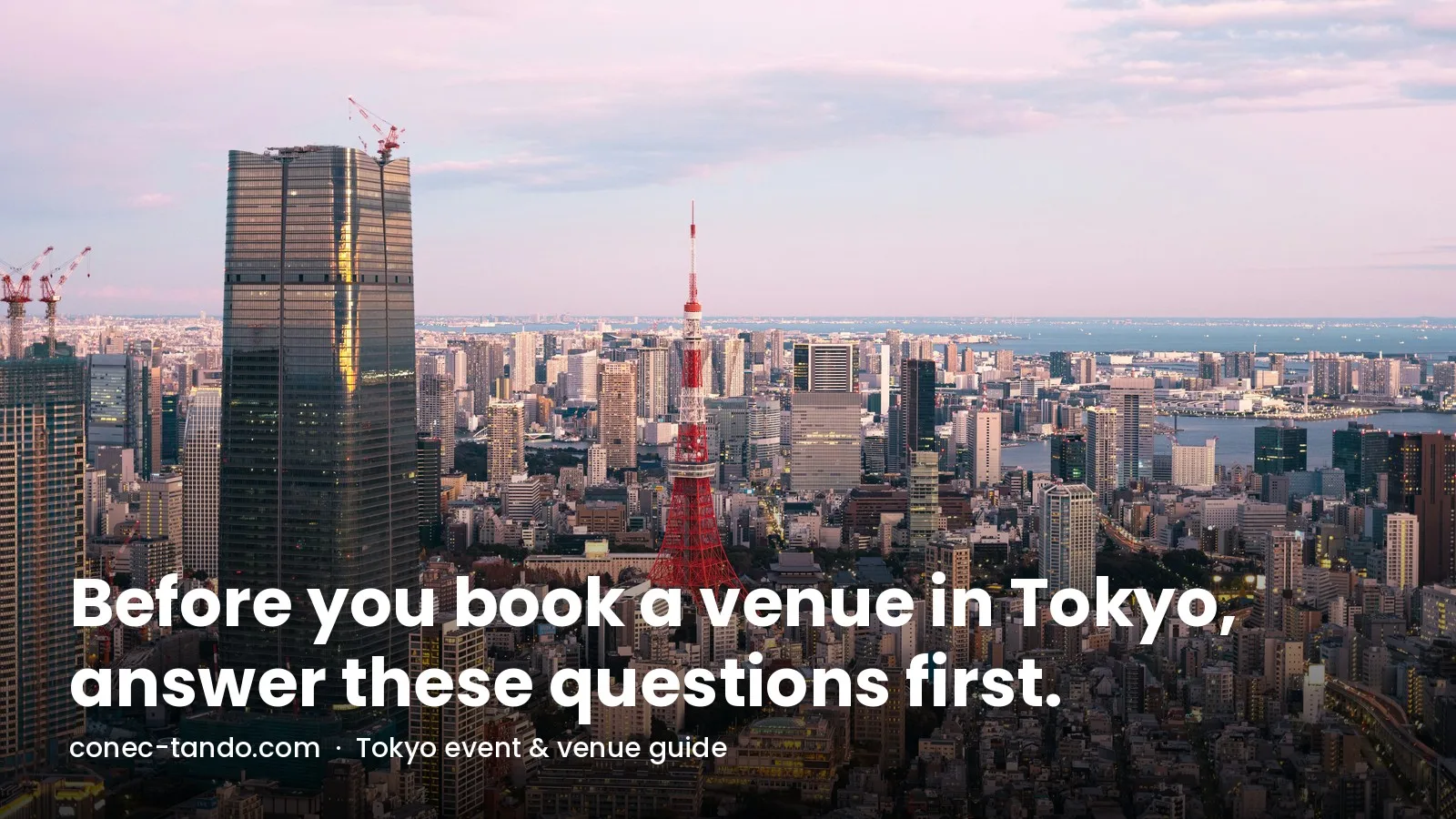
Photo by ueruko on Unsplash
How to Organize an Event in Tokyo: What a Local Asks Before Talking About Venues
Organizers often ask where to rent a venue first. A local asks six other questions before that. This is the order I actually follow until a venue is decided.
Organizers from overseas often ask me, "We want to run an event in Tokyo. Where should we rent a venue?" When I hear that, I don't start with venues. There are a few things that need to be settled first, or everything gets redone later. This article walks through the questions I actually ask, in the order I ask them, until a venue is decided.
What I ask first
The first things I ask for are the timing, the number of attendees, the purpose, and, if possible, the budget. It also helps enormously if you can share a link to an event you have already run overseas: a website or a recap. It shows the atmosphere, the kind of people who attend, and the scale, all at a glance.
Timing: does it clash with a major event in your industry?
This is not specific to Tokyo, but if your dates fully overlap with a major event in your industry, people won't come. For startups, that means events like IVS (held in Kyoto) and SusHi Tech Tokyo. If you are in a different industry, overlapping is not a problem. The reverse can also work: scheduling close to those dates on purpose, to catch people who are already in Japan.
Attendees: do you really need that many?
Many organizers tell me, "We get 1,000 people back home." It is worth pausing to ask whether the first edition in Tokyo needs the same number. Your event back home probably didn't start that big either. If the venue looks empty at the first edition, the event becomes hard to continue. I have seen many events that ended after one edition.
Budget: what is left after the venue?
I ask about the budget early to avoid one specific situation: the venue eating the entire budget. The size and type of venue should be decided after you see what remains once the venue is paid for. I wrote about the cost breakdown in How Much Does an Event in Tokyo Cost?.
Area: your industry largely decides the location
The area is largely determined by the industry. For startups, for example, Shibuya and Roppongi are common. At the same time, areas that want to attract your industry sometimes offer venues at lower rates. Toranomon is one example.
 First-Time Visitor’s Guide to TORANOMON HILLS FORUM | BizinTokyo
Thanks to rapid redevelopment in recent years, the Toranomon area has evolved into one of Tokyo’s most innovative global business hubs. If you’re visiting Japan for the first time in a few years—or at
bizintokyo.com
Public facilities: sometimes free or low-cost
Some public facilities, including those run by the Tokyo Metropolitan Government, can be used free of charge or at low cost. Tokyo Innovation Base (TIB) is one example. Availability is limited and there are conditions for use, so if it could work for you, it is worth checking early.
 Tokyo Innovation Base (TIB) Access & Visitor Guide | BizinTokyo
Tokyo Innovation Base (TIB) is a startup support hub operated by the Tokyo Metropolitan Government, located in the Yurakucho area. Just a 6-minute walk from Tokyo Station and 1 minute from JR Yurakucho Station, it is one of the most accessible venues in central Tokyo. This guide covers how to get to TIB, venue details, and nearby hotels and restaurants for business travelers.
bizintokyo.com
Booking: popular venues fill up a year ahead
Popular venues can be booked out a year in advance. So rather than narrowing down to one venue, I start by contacting several and collecting candidates and their availability.
Only then do we talk about venue type
Timing, attendees, purpose, budget, area, and booking outlook. Once these are settled, we can finally talk about whether it should be a hotel, a rental hall, or a convention center. I covered the differences between types in Five Types of Event Venues in Tokyo.
To check venue availability and locations, see bizintokyo.
Planning an event in Tokyo? A rough idea is enough to start.
Contact