 Conectando
You don't need to speak Japanese to run an event in Tokyo — you need one specific person
Not speaking Japanese is not what stops overseas organizers from running events in Tokyo. What stops them is not having one bilingual person who understands how events actually work here. This article explains what that person does for you, why it matters more than anything else, and how you talk to Japanese guests and staff yourself in the moments that person isn't beside you.
Is the language barrier really that big?
Many overseas organizers assume it is difficult to run an event in Japan without speaking Japanese. Japanese is certainly the main language on the event floor. But the organizer does not need to speak it. With the right setup, an event in Tokyo can be run without the organizer using a word of Japanese.
The catch is in "the right setup". It is not what most people expect.
Contents
- Why the organizer's Japanese level doesn't matter
- The one person you actually need
- What that person handles for you
- Talking to Japanese guests and staff yourself
- FAQ
1. Why the organizer's Japanese level doesn't matter
Venues and suppliers in Japan work in Japanese. That is a fact, but it is not a problem in itself: you leave the Japanese-language work to people on site who do it every day, the same way you would in any other country where you don't speak the language.
The real difficulty is different. When your guests are English speakers, you need staff who can deal with them in English. In the Japanese events industry, staff like that are hard to find — and that, not the organizer's Japanese, is what needs to be prepared for.
2. The one person you actually need
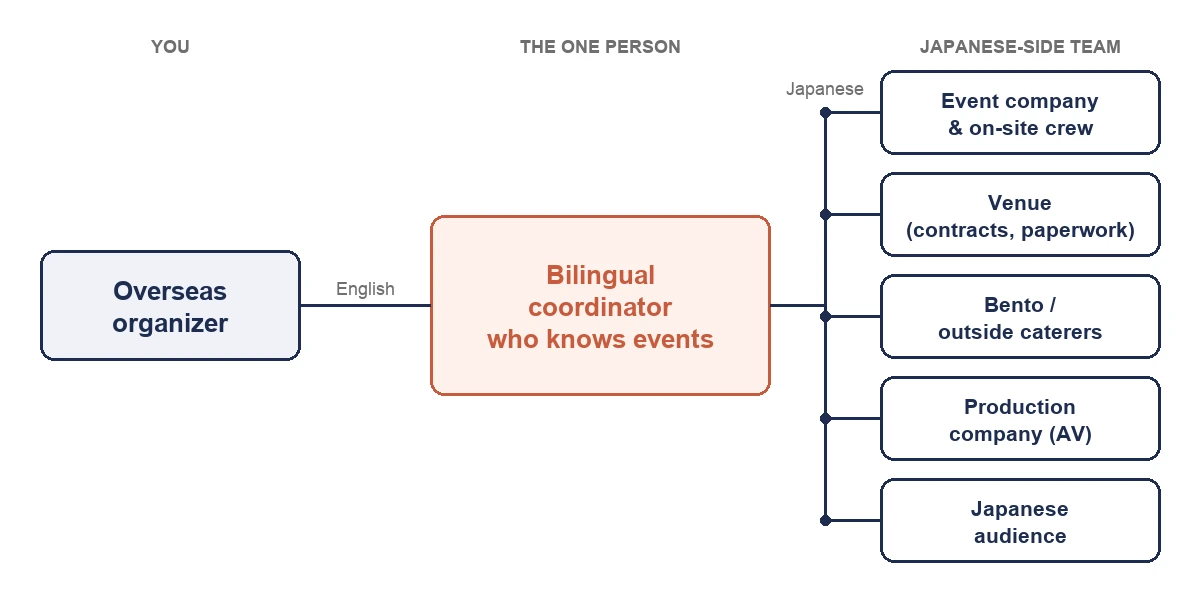
What you need is not a team that speaks Japanese. It is one interpreter or coordinator who knows events.
A general interpreter converts words. An interpreter who knows events already understands the vocabulary, the order things happen in, and what a venue means when it says something. Communication with the venue and suppliers becomes fast and reliable, and small on-site adjustments — the kind that happen all day during a live event — get handled without everything coming back to you.
This person does not run the stage, the sound or the registration desk themselves. A Japanese event company and its on-site crew do that, the same way they do for any Japanese client. The coordinator's job is to stand between you and that Japanese-side team: to carry your intentions into Japanese, and to bring the team's decisions and questions back to you in English.
With that one person in place, the organizer does not need Japanese at all. Without that person, even a team with some Japanese ability will struggle.
3. What that person handles for you
To see why this one person matters so much, look at what they take off your plate. These are the parts of a Tokyo event that, in practice, happen in Japanese — with the event company, the venue, the suppliers and your Japanese guests:
- Venue contracts and paperwork. An English contract is not something you can count on, even from large venues and hotels. Enquiries and viewings are often possible in English; the documents usually are not. Your coordinator reads them and tells you what matters.
- Food orders outside hotel catering. Bento and boxed lunches, and caterers outside the hotel, are as a rule ordered in Japanese. English-speaking suppliers exist here and there, but you cannot plan around finding one. Your coordinator places the order.
- AV and production companies. Finding a production company (sound, video, staging) that can work in English is genuinely difficult. With a coordinator, you don't have to: you can use a Japanese production company, and the coordinator handles the communication.
- Your Japanese audience. If you hold an event in Japan, your main audience is Japanese. Everything they see — the event website, the advertising, the registration, the emails — has to be in Japanese. Even Japanese people who are quite comfortable in English will, in practice, ignore an English-only email or site. Your coordinator makes sure the Japanese version exists and reads the way a Japanese guest expects.
None of these is a wall once the right person is in place. All of them are walls without that person.
4. Talking to Japanese guests and staff yourself
Your coordinator cannot be next to you every second. There will be moments when you, the organizer, want to speak directly with a Japanese guest or a member of the Japanese staff — a quick question, a thank-you, a small instruction.
For those moments, use digital tools. Translation apps on your phone are good enough for short, everyday exchanges with guests and staff, and using them yourself is faster than waiting for the coordinator to come over.
Keep the important conversations — with the venue, with suppliers, anything involving money or the schedule — for the coordinator. Use the tools for everything small.
FAQ
Can I run the whole event with a regular interpreter? You can communicate, but a general interpreter does not know how events run here, so every adjustment on the day comes back to you. An interpreter who knows events handles those directly.
Do I need a production company that speaks English? No, and looking for one is one of the hardest things to do in Tokyo. Use a Japanese production company and let your coordinator handle the communication.
My Japanese guests speak English. Can I run promotion and registration in English only? No. In practice, even English-comfortable Japanese guests ignore English-only emails and sites. If the event is in Japan, your main audience is Japanese, and everything they see should be in Japanese.
Does the coordinator replace a Japanese event company? No. You still work with a Japanese event company and its crew for staging, sound, registration and the rest. The coordinator is the person who connects you to them in English.
How do I talk to Japanese guests or staff when the coordinator isn't with me? Use a translation app on your phone. It is enough for short exchanges. Save the important conversations for the coordinator.
Planning an event in Tokyo?
If you are wondering whether your event can run without Japanese, we are happy to look at your plan and tell you where it can and where it can't.
Planning an event in Tokyo? A rough idea is enough to start.
Contact